Electronic Contract Manufacturing Service Provider in California

What Is the Best PCB Board Manufacturing Company in China?

Choosing the best PCB board manufacturing company in China starts with matching its capabilities to your product, not trusting a ranking alone. A prototype with a simple two-layer stackup has different needs from a dense multilayer board with controlled impedance. The right partner should explain those differences clearly.

Details matter. Ask how the factory handles layer registration, copper thickness, drilling tolerances, solder-mask clearance, and electrical testing. Request sample inspection records, relevant certifications, and a clear quotation that separates tooling, materials, testing, and shipping. These details help buyers compare suppliers on more than price. They also reveal whether the sales team understands the engineering requirements or is simply repeating a standard offer.

This guide examines practical ways to assess manufacturers, including production capacity, engineering support, quality controls, lead times, and communication. It also highlights questions worth asking before sending design files or approving a first article. A responsive supplier may still have limits in specialist materials or rush production. No company fits every project. A polished website is not proof of consistent output, and a low quote deserves careful review. Compare documented capabilities, inspect samples where possible, and confirm specifications in writing. The strongest choice is the manufacturer whose evidence and process fit your board, budget, and schedule.
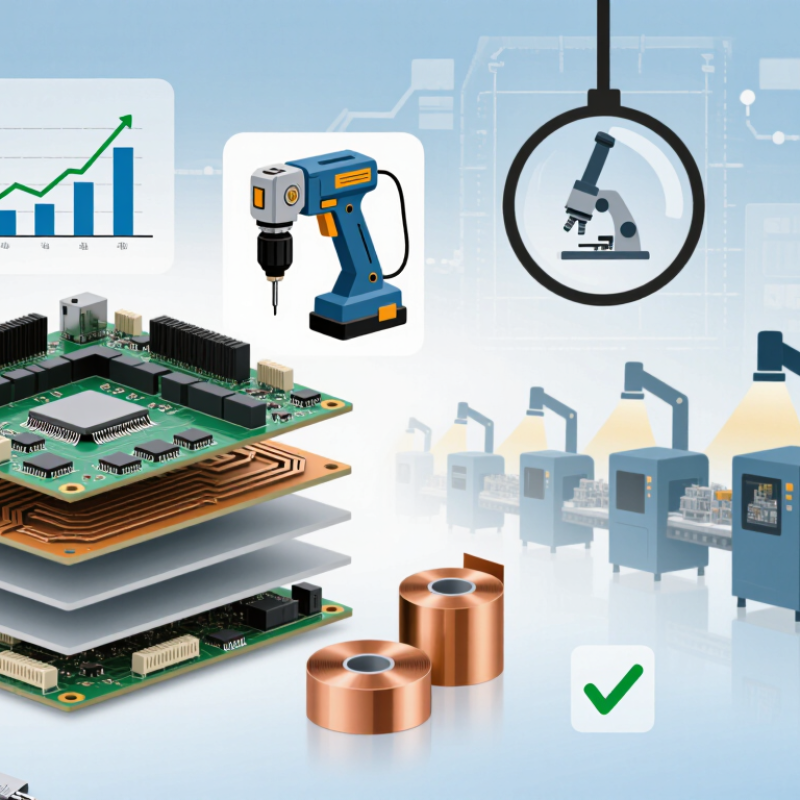
What Is the Best PCB Board Manufacturing Company in China?

What a PCB Manufacturing Company Does

A PCB manufacturing company turns a circuit design into a physical board. Its work can include checking design files, selecting materials, producing copper patterns, drilling holes, and applying protective finishes. Grand View Research estimated the global PCB market at about USD 75.2 billion in 2023, reflecting demand across electronics sectors. That figure describes the market, not the quality of any individual factory. The details matter.

Production usually starts with a design review. Engineers check clearances, layer stack-ups, hole sizes, and whether traces can be etched reliably. A fabrication team then laminates copper-clad layers, transfers circuit patterns, and drills connections between layers. For a multilayer board, alignment is critical; a small shift can interrupt a connection. After plating and finishing, the board is inspected for shorts, open circuits, and dimensional errors. Testing may include electrical continuity checks.

A capable manufacturer also flags problems before production, rather than simply accepting every file. IPC standards such as IPC-6012 describe qualification and performance requirements for rigid printed boards, while IPC-A-600 provides visual acceptance criteria. These references help customers discuss measurable quality. Ask how the factory handles test reports, traceability, and design changes. A polished sample is useful, but it cannot reveal every process weakness. And no process is perfect. Clear communication helps, though I would still review the first production run carefully.

Key Criteria for Evaluating PCB Manufacturers in China

What Is the Best PCB Board Manufacturing Company in China?

Key Criteria for Evaluating PCB Manufacturers in China

Choosing a PCB manufacturer is less about finding the lowest quote and more about matching its capabilities to your board. Prismark’s 2024 industry analysis reported that global PCB production value fell about 15% in 2023, to roughly US$68.6 billion. Market pressure can affect prices, but it does not tell you whether a factory can hold your required tolerances. Check its experience with your layer count, materials, copper weights, and expected order volume.

Review documented quality controls, engineering support, and production traceability. Ask how the supplier handles design-for-manufacturing feedback, electrical testing, and defects found during inspection. Request sample inspection records and clarify whether its processes align with relevant IPC performance and acceptance standards. For a multilayer board, examine the actual drill and registration capabilities, not just a general capability sheet. A clean sample is useful; repeatability across production lots matters more. I still find lead-time promises easy to overvalue.

Tips: Send the same fabrication package to each candidate, including Gerbers, drill files, stack-up, and quantities. Compare written answers on tolerances, test coverage, panelization, and delivery dates. Ask for a recent, anonymized lot report. Small details matter. Then evaluate communication: clear questions about your design often reveal more than polished sales language.

Production Capabilities and Quality Standards

Choosing a PCB manufacturer means examining repeatable production, not just quoting price or board size. IPC’s World PCB Production Report 2022 estimated global PCB production at 82.7 billion US dollars, with China representing 54.6 percent of output. That scale supports broad sourcing and process experience, but it does not prove any factory can meet a specific design. Scale matters.

Ask how the plant handles your layer count, minimum trace width, copper weight, and finished-board thickness. Request capability limits and recent examples for comparable boards. A well-run process should include documented material controls, drill registration checks, automated optical inspection, and electrical testing. For controlled-impedance designs, ask to see the test coupon results and measurement method. Details matter.

Quality should be tied to a defined acceptance standard, such as IPC-A-600 for board acceptability and IPC-6012 for rigid-board qualification. Ask for inspection records, microsection reports, and lot traceability, not only a certificate. I would not treat a clean audit file as proof of perfect production; defects can still occur. Check how the supplier records nonconformances, investigates root causes, and verifies corrective actions. A small first-article run can reveal issues before larger orders, though it cannot replace ongoing process monitoring.

PCB Production Capabilities: Nominal Copper Thickness

A practical benchmark for comparing copper-weight options in PCB manufacturing.

Copper thickness is approximately 34.8 μm per oz/ft²: 0.5 oz is about 17 μm, 1 oz about 35 μm, 2 oz about 70 μm, and 3 oz about 105 μm. These are nominal foil values; finished-board copper can vary with plating and processing. Confirm the required stack-up and applicable IPC acceptance criteria when evaluating production capability and quality.

How to Compare PCB Manufacturers

How to Compare PCB Manufacturers

A low quoted price can hide costly gaps. Compare manufacturers using the same board files, quantities, and delivery terms. Check layer count, finished copper weight, minimum trace width and spacing, hole tolerance, and surface finish. Ask for capability tables, sample inspection records, and a clear process for reporting defects. A polished website proves little.

Prismark’s 2024 industry review estimated global PCB production value fell 15.6% in 2023, to about US$69.5 billion.

That downturn makes financial resilience worth checking alongside technical skill. Ask how the supplier manages material shortages, capacity changes, and urgent orders. Request lead-time figures for your actual board type, not a generic promise. Then compare first-article inspection, electrical testing, and traceability requirements. Details matter.

Look for documented quality controls and evidence that the factory can repeat your design reliably. Clarify what happens when a batch fails inspection, including response time and corrective action. A spreadsheet can still mislead. Price, yield, and delivery should be judged together, using written quotes and comparable specifications.

I would also verify claims with a small pilot order; it adds time, but may reveal gaps that a sales call misses. No score is perfect.

Choosing a Manufacturer for Your Project

Choosing a manufacturer means matching its process to your board, not simply comparing prices. China remains a major production hub: IPC’s World PCB Production Report 2022 estimated that mainland China represented about 54.6% of global PCB production value. Scale can offer broad process options, but it does not prove that a specific factory can meet your requirements. Ask for evidence tied to your design: impedance-control results, microsection images, solder-mask registration, and documented inspection criteria. For a prototype, check how quickly engineering questions receive clear answers. For volume production, examine capacity, lot traceability, and how the supplier handles process changes. Small details matter.

Market conditions also affect quotations. Prismark reported that global PCB production value fell about 15% to US$72.3 billion in 2023, underscoring how demand and utilization can shift. Compare quotes on the same stack-up, copper weight, finish, testing, and delivery terms. A low number may exclude tooling or electrical testing. Ask what is not included. Request a pilot run and review the actual panels, not just a presentation. Check whether corrective-action reports identify causes and verify fixes. I would not treat a polished factory tour as proof; it can still leave gaps. Share files securely, agree on revision control, and confirm who approves deviations before production begins.

What Is the Best PCB Board Manufacturing Company in China? — Choosing a Manufacturer for Your Project

Selection Criterion Prototype and Low-Volume Builds Standard Production High-Reliability or Complex Boards What to Confirm Before Ordering
Typical project fit Design validation, samples, and small batches where speed and engineering feedback matter. Repeated orders with stable specifications and moderate-to-high production quantities. Boards with demanding electrical, thermal, mechanical, traceability, or regulatory requirements. Ask for examples of comparable layer counts, materials, tolerances, and production volumes.
Layer-count capability Commonly 1–8 layers; some facilities support more. Commonly 2–16 layers, depending on stack-up and board construction. May support 16 or more layers, but capability varies substantially by process and design. Request the manufacturer’s current capability sheet and confirmation for your exact stack-up.
Typical lead time About 5–10 business days for many standard prototypes. Often about 2–4 weeks after data approval for standard production. Often about 3–6 weeks or longer for complex materials, special processes, or qualification builds. Confirm whether the estimate includes engineering review, testing, holidays, and shipping. Expedite options may affect cost and inspection time.
Minimum order quantity Small quantities are often available, subject to panelization and setup costs. Usually priced around the required batch size and production panel utilization. May require larger qualification or traceability lots, depending on the process and end use. Request pricing at several quantities and clarify tooling, setup, and unused-panel charges.
Line width and spacing 4/4 mil (about 0.10/0.10 mm) is a common standard capability; finer features may be available. 4/4 mil is common for many designs; achievable limits depend on copper weight and layer construction. Finer features, such as 3/3 mil (about 0.076/0.076 mm), may be possible with suitable processes and design review. Check the limits for inner and outer layers separately, including finished copper thickness and yield implications.
Materials and copper Standard FR-4 and common copper weights are widely available. FR-4, high-Tg laminates, and heavier copper may be available by specification. Specialty high-frequency, high-speed, thermal, or mixed-material constructions may require a qualified process. Specify the laminate, Tg or electrical properties, copper weight, stack-up, and any approved substitutions.
Testing and inspection Electrical open/short testing is commonly offered; flying-probe testing is often used for prototypes. Electrical testing may use flying probes or dedicated fixtures; visual and process checks vary. Additional controls may include documented inspection plans, microsection analysis, or lot traceability when specified. Define test coverage, acceptance criteria, inspection records, and whether test fixtures or reports are included.
Quality-system evidence Useful for any project, especially when repeatability and corrective-action handling matter. Important for repeat orders, supplier approval, and consistent process control. Essential when required by the application or customer quality plan. Verify current certificates and scope directly. Depending on the application, ask about ISO 9001, IATF 16949, ISO 13485, or applicable UL recognition; do not assume every supplier holds them.
Engineering support Look for prompt design-for-manufacture feedback on clearances, drill sizes, and panelization. Look for controlled revision handling and documented approval before production. Look for stack-up review, process-risk discussion, and support for qualification documentation. Send fabrication data and ask for a written review of risks, assumptions, and proposed changes before release.
Cost and delivery considerations Low unit cost is not always the priority; engineering and expedited services can add charges. Panel utilization, material choice, yield, and order quantity affect unit price. Special materials, tighter tolerances, testing, and documentation can increase both cost and lead time. Compare like-for-like quotations, Incoterms, packaging, shipping, payment terms, and rework or claims procedures.

Note: The figures above are general planning ranges, not guaranteed capabilities or delivery commitments. Actual limits, pricing, and lead times depend on the design, materials, order quantity, factory process, and shipping method. The best manufacturer is the one that can document a reliable fit for your specific requirements.