Understanding the Top Circuit Board Assembly Techniques and Trends?
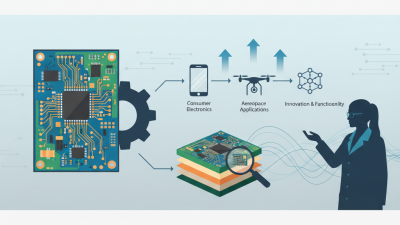
The world of circuit board assembly is evolving rapidly. In 2022, the global market for circuit board assembly reached approximately $40 billion. This growth is driven by advancements in technology and consumer demand for electronic products. Companies are focusing on optimizing their assembly techniques to enhance efficiency and reduce costs.
Recent trends in circuit board assembly include automation and smart manufacturing. These innovations improve accuracy and reduce errors. According to industry reports, automated processes can increase production speed by 30%. However, not all companies have adopted these technologies. There remain challenges in workforce training and equipment investment.
As the market evolves, sustainability is also becoming a focus. Companies aim to reduce waste in circuit board assembly. There is increasing pressure to implement eco-friendly practices. Yet, achieving this balance between efficiency and sustainability requires continuous effort and reflection.

Top Circuit Board Assembly Techniques in Current Industry Practices
In the world of electronics, circuit board assembly techniques have evolved significantly. Precision is key, yet some methods still face challenges. Surface mount technology (SMT) remains prevalent. This technique allows components to be mounted directly onto the surface of the PCB. It greatly reduces space. However, it requires precise alignment. Misalignment can lead to faulty connections.
Another popular approach is through-hole technology. This involves inserting components into holes drilled in the PCB. While reliable, it can be time-consuming. It is also less suited for compact designs. There are instances where this method may lead to excessive lead exposure. This can affect the overall integrity of the board.
Recently, automated assembly has gained traction. Machines can assemble boards faster than humans. They minimize errors and increase production speed. However, automation comes with drawbacks. Initial setup costs can be high, and machines require maintenance. The balance between efficiency and cost-effectiveness needs careful consideration.
Understanding the Top Circuit Board Assembly Techniques and Trends
| Assembly Technique |
Description |
Current Trend |
Applications |
| Surface Mount Technology (SMT) |
A method where components are mounted directly onto the surface of the PCB. |
Increasing use of automation and robotics. |
Consumer electronics, automotive, and telecommunications. |
| Through-Hole Technology (THT) |
Components with leads that are inserted into holes and soldered on the opposite side. |
Hybrid assembly methods combining THT and SMT. |
Industrial and military applications. |
| Wave Soldering |
A technique where PCB is passed over a wave of molten solder. |
Adoption of lead-free soldering due to regulations. |
High-volume production electronics. |
| Reflow Soldering |
Used for SMT components where solder paste is melted to form joints. |
Increased integration of IoT devices. |
Smart devices and gadgets. |
| Selective Soldering |
Involves soldering specific areas of a PCB using a precision soldering process. |
Growing interest in reducing costs and waste. |
Complex PCB designs in low-volume production. |
Overview of Surface Mount Technology (SMT) Demographics and Statistics
Surface Mount Technology (SMT) is pivotal in modern circuit board assembly. It has revolutionized how components are attached to substrates. SMT allows for the placement of components directly on the surface of a PCB, reducing space and increasing efficiency. With smaller components, manufacturers can create compact devices.
Statistical data highlights the rising adoption of SMT across various industries. Recent studies suggest that over 80% of new electronic designs utilize this technology. However, this rapid growth raises some concerns. Quality control is often compromised when speed is prioritized. There are instances where components are misaligned, leading to malfunction.
Moreover, the demographics of SMT usage vary. Certain regions excel in this technique while others lag behind. Industries like automotive and consumer electronics dominate in SMT applications. However, smaller manufacturers struggle to keep pace. This inconsistency presents a challenge for the entire sector. As SMT technology evolves, addressing these issues will be vital for future advancements.
Understanding the Top Circuit Board Assembly Techniques and Trends
Exploring Through-Hole Technology: Advantages and Market Trends
Through-hole technology remains a significant assembly method in the electronics industry. This approach has distinct advantages, particularly in mechanical strength. Components are inserted through holes in the circuit board. The leads are then soldered on the opposite side. This produces durable connections, which are crucial for high-reliability applications.
Market trends indicate a resurgence of through-hole technology. Many manufacturers appreciate its ease of repair and modification. For bulky components or those that require high integrity, through-hole provides an edge. However, there are challenges. The assembly process is often slower compared to surface-mount techniques. This can lead to higher production costs. Companies must weigh these factors when choosing assembly methods.
Despite its strengths, through-hole can be limited. The size of components can restrict design flexibility. Additionally, the prevalence of surface-mount technology poses a constant challenge. The industry must adapt to these trends while considering through-hole advantages. A balance is needed to blend reliability with efficiency in modern circuit board design.
Innovations in PCB Design: Impact on Manufacturing Efficiency and Cost
In recent years, innovations in PCB (Printed Circuit Board) design have significantly transformed manufacturing efficiency and cost-effectiveness. Advanced software tools enable engineers to create more complex layouts while minimizing the use of materials. This not only reduces waste but also speeds up the production process. Automation in assembly is another trend, allowing for precision that manual processes cannot achieve. However, reliance on automation can pose challenges, such as an over-dependence on machines that might fail.
The integration of IoT (Internet of Things) in PCB manufacturing further highlights the intricate relationship between technology and efficiency. Smart factories utilize real-time data to optimize production lines. This ensures that any issues are addressed promptly, leading to reduced downtime. On the flip side, the adoption of such technologies requires significant investment upfront. Smaller manufacturers may struggle to keep up. The balance between adopting new tech and ensuring affordability remains a question to ponder for many in the industry.
Despite these advancements, challenges persist. The complexity of modern PCBs often leads to longer design cycles. Engineers find themselves navigating through intricate designs that require ample testing before mass production. This can delay product launches, frustrating stakeholders. Evaluating these trade-offs is essential for manufacturers aiming to stay competitive while ensuring quality and cost-effectiveness.
Emerging Trends in Automation and Robotics in Circuit Board Assembly
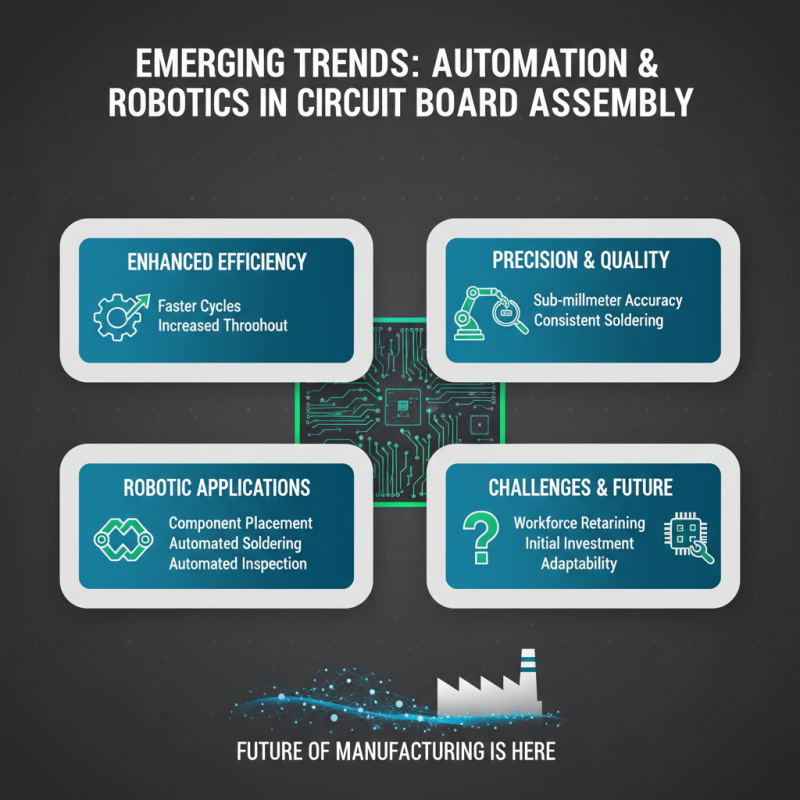
The landscape of circuit board assembly is evolving rapidly. Automation is at the forefront, enhancing efficiency and accuracy. Machines can now handle components with precision that surpasses human capability. Robots are automating soldering processes, ensuring consistent quality. This leads to faster production cycles, but it also raises challenges.
While automation streamlines operations, it may not solve all issues. There’s a learning curve for workers adapting to these technologies. Training and upskilling are crucial for a smooth transition. As robots handle more complex tasks, the potential for errors increases if not carefully monitored. Balancing automation with human oversight is vital to avoid costly mistakes.
The push for smart factories is driving innovation. Real-time data tracking can optimize workflows and identify bottlenecks. However, companies must remain cautious. Integrating new systems often presents unexpected hurdles. The vision of a fully automated assembly line may still be some way off. Experimentation and adaptation will be key as the industry seeks to harness these emerging technologies effectively.