What is a Regulated Power Supply and How Does it Work?
In today's technology-driven world, a Regulated Power Supply is essential for stability and efficiency in electronics. Experts like Dr. Emily Chen, a leading engineer in power systems, emphasize its importance, stating, "Without a regulated power supply, devices cannot perform reliably." This highlights the critical role these systems play.
A regulated power supply ensures consistent voltage and current to devices. It adapts to fluctuations in input voltage and load conditions, maintaining stability. This performance is vital for sensitive equipment. For example, microcontrollers and communication systems rely heavily on these power supplies. Any instability can lead to malfunctions or data loss.
However, not all regulated power supplies are perfect. Designing them involves trade-offs between size, efficiency, and cost. There are challenges to overcome, such as heat dissipation and component selection. Understanding these factors is crucial for engineers. Ultimately, the quest for the ideal regulated power supply is ongoing, pushing the boundaries of technology.
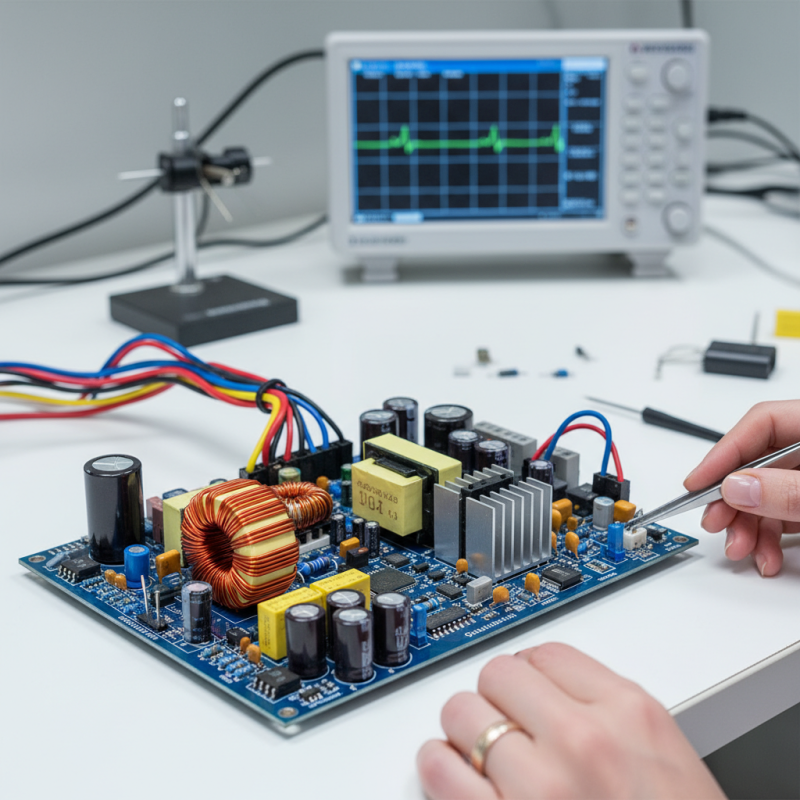
What is a Regulated Power Supply?
A regulated power supply is an essential component in many electronic systems. It regulates voltage and current, ensuring stability. This is crucial in maintaining the performance of sensitive equipment. According to a report by the International Electrotechnical Commission, around 70% of electronic failures stem from power supply issues. A well-designed regulated power supply can mitigate these risks significantly.
These power supplies utilize feedback mechanisms to adjust output. They actively compare the output voltage to a reference voltage. If there is a discrepancy, the system modifies the output to correct it. However, not all designs achieve perfect performance, and some may struggle under varying load conditions. In fact, an industry study highlighted that 25% of regulated supplies face efficiency losses, especially at low loads.
Moreover, the need for compact designs often leads to trade-offs. Engineers might prioritize size over performance, which can lead to overheating or reduced lifespan. For instance, a regulated power supply that runs at high temperatures could decrease efficiency by 15%. This illustrates the importance of balance in design, emphasizing that challenges in achieving optimal performance are common.
Power Supply Voltage Regulation
Components of a Regulated Power Supply
A regulated power supply ensures that devices receive a stable voltage. This is crucial for efficient operation. Its main components include transformers, rectifiers, filters, and voltage regulators.
Transformers step down or step up voltage. They change high voltage to low and vice versa. However, they can introduce noise, which is something to consider.
Rectifiers convert AC to DC. They can be half-wave or full-wave types. Each type has its pros and cons. Half-wave rectifiers are less efficient. But they are simpler and cheaper.
Filters smooth out the DC output. Capacitors are commonly used here. They can hold charge but might leak. This leakage can lead to undesirable fluctuations.
Voltage regulators maintain a steady output voltage. They can be linear or switching regulators. Linear ones are simpler and quieter. Switching regulators are more efficient but can add ripple.
Tips: Always check the specifications of each component. Matching the right components ensures better performance. Testing your setup in stages can identify issues early.
What is a Regulated Power Supply and How Does it Work? - Components of a Regulated Power Supply
| Component | Function | Typical Voltage Rating (V) | Typical Current Rating (A) |
| Transformer | Steps voltage down to the required level | 120 / 240 | 5 - 10 |
| Rectifier | Converts AC voltage to DC voltage | - | - |
| Filter Capacitor | Smooths out the ripple in DC output | - | - |
| Linear Regulator | Maintains a constant output voltage | 5 / 12 / 15 | 1 - 3 |
| Switching Regulator | Efficiently converts voltage levels with less heat | 5 / 12 / 24 | 1 - 10 |
| Output Capacitor | Stabilizes the output voltage | - | - |
How Regulated Power Supplies Work
Regulated power supplies are essential in many electronic devices. They provide a stable output voltage, regardless of variations in input voltage or load current. This stability is crucial for sensitive applications, such as medical equipment and communication systems. A regulated power supply stabilizes output voltage by using components like voltage regulators.
How do they achieve this? The key is feedback control. A regulator continuously monitors output voltage. If it detects a change, it adjusts the input. This can involve reducing or increasing the power supply's output. Often, this process is not perfect. Sometimes transient responses take longer. Delays can occur, which may affect device performance. Additionally, if the load varies significantly, the system may struggle to keep up.
Another detail worth noting is the types of voltage regulation. Linear and switching regulators are two common types. Linear regulators offer simplicity and low noise. However, they can be inefficient, especially with larger voltage drops. Switching regulators are more efficient but can introduce noise. Understanding these trade-offs is vital for selecting the right power supply for a project. Each option has benefits and drawbacks to consider. Always reflect on the specific needs of your application when choosing a regulated power supply.
Types of Regulated Power Supplies
Regulated power supplies play a critical role in electronics. They provide stable voltage output, minimizing fluctuations. This stability is vital for sensitive devices. There are several types of regulated power supplies.
Linear power supplies are the simplest type. They use components that deliver a constant output voltage. However, they can be inefficient and generate heat. Switching power supplies are another popular choice. They convert power more effectively, producing less heat. But they can introduce noise into the output, which may affect sensitive circuits.
When selecting a regulated power supply, consider the application. A linear supply may be best for audio equipment. In contrast, switching supplies work well in computer applications.
Tip: Always check the specifications. Make sure the voltage and current ratings match your needs. Understanding the requirements can save time and increase efficiency.
Using the wrong power supply can lead to issues. Overvoltage may damage components. Undervoltage might result in erratic behavior. It's essential to choose wisely and test thoroughly.
Applications of Regulated Power Supplies
Regulated power supplies are essential in many applications across multiple industries. Their ability to provide stable voltage and current is critical for sensitive electronic devices. For instance, in the medical field, regulated power supplies ensure that life-support equipment operates correctly. According to a recent industry report, about 60% of medical devices rely on regulated supplies for their functionality.
In telecommunications, these power supplies maintain proper functioning. They support the continuous operation of networking equipment. Any voltage fluctuation can lead to data loss or equipment damage. A study shows that companies that invest in quality regulated power supplies can reduce downtime by 30%. This improvement is vital as downtime can be costly.
The automotive industry also benefits from regulated power supplies. Vehicles now integrate complex electronic systems that require consistent power. Interestingly, as electric vehicles rise, the demand for reliable power sources increases. However, challenges still exist. Some power supplies struggle to meet the required efficiency standards. Addressing these issues is crucial for future developments. Ensuring compact design while maintaining performance can lead to significant advancements.