Electronic Contract Manufacturing Service Provider in California

China Best Automotive Battery Tester Suppliers

Choosing among China’s best suppliers of Automotive Battery Testers requires more than comparing screen sizes or quoted prices. A workshop needs repeatable results, clear reports, and dependable support when a vehicle will not start on a cold morning. The International Energy Agency reported nearly 14 million electric-car sales worldwide in 2023, about 18% of total car sales. That shift adds battery complexity, while conventional 12-volt batteries still serve millions of vehicles. One market is changing quickly. The other remains essential.

For buyers, an Automotive Battery Tester should match real service work: testing battery health, starting performance, and charging systems, with suitable coverage for the battery types handled. The U.S. Department of Energy’s Alternative Fuels Data Center documents the growing range of vehicle technologies, a useful reminder that one test method may not fit every vehicle. Battery researcher Dr. David A. J. Rand has published extensively on lead-acid battery performance. A practical lesson from that field is simple: “A voltage reading alone does not tell the whole story.” It is a diagnostic principle, not a substitute for verified product specifications.

This guide compares China-based suppliers by product range, documentation, calibration options, software usability, and after-sales service. Ask for sample reports. Check how the tester behaves with a weak battery and a stable one. Small details matter. Supplier claims can sound alike, and published specifications may leave gaps. That deserves a closer look. The strongest choice is not automatically the cheapest; it is the supplier that can demonstrate consistent results and support the tool after delivery.
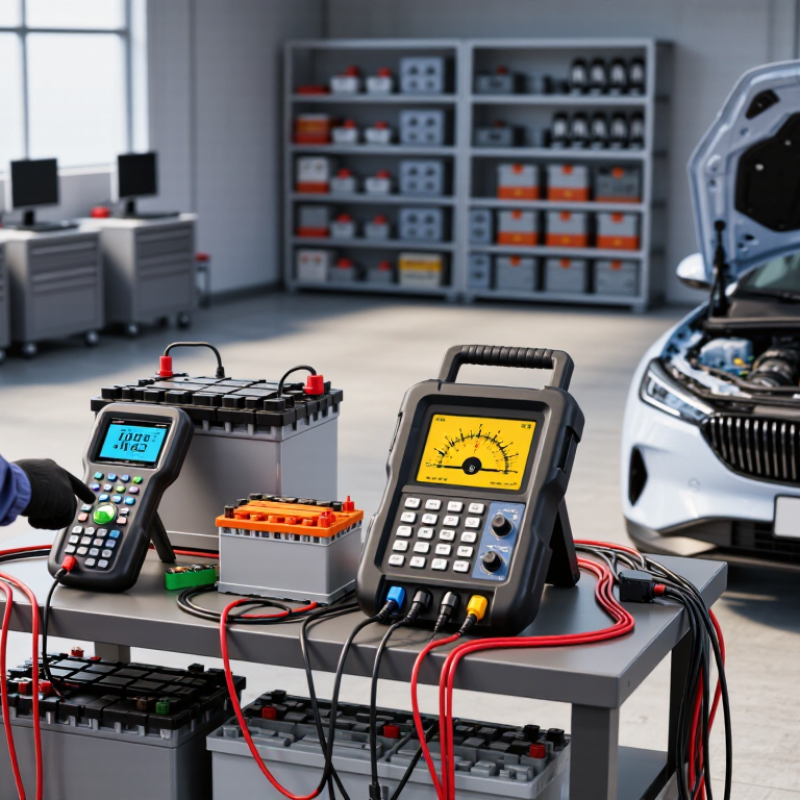
China Best Automotive Battery Tester Suppliers

What Automotive Battery Testers Measure and How They Work

An automotive battery tester checks voltage, starting power, and battery condition. A conductance tester sends a small signal through the battery, then estimates cold-cranking amps (CCA) and internal resistance. A load tester applies a heavier current to see whether voltage collapses. These results are not interchangeable: resting voltage mainly reflects charge, while CCA indicates starting ability. A battery can show normal voltage and still struggle on a cold morning.

SAE J537 provides a useful industry benchmark: its cold-cranking test evaluates a 12-volt battery at -18°C for 30 seconds. The battery must maintain at least 7.2 volts while delivering its rated CCA. This is a demanding test, not a full diagnosis of every battery fault. Temperature, recent charging, and poor terminal contact can distort readings. One number can mislead.

Tips: Clean the terminals, switch off vehicle accessories, and follow the tester’s prompts. Test after charging, or note that a low reading may reflect discharge rather than battery wear. A second test can help.

Key Technologies Used in Modern Battery Testing Equipment

China Best Automotive Battery Tester Suppliers

Key Technologies Used in Modern Battery Testing Equipment

Modern automotive battery testers combine electrical measurement with software analysis. Conductance and impedance methods estimate a battery’s condition without fully discharging it. For workshop checks, this can save time. Four-wire Kelvin connections reduce errors caused by test-lead resistance, especially when measuring low voltage drops. Some units also apply a controlled load to check how voltage behaves under demand.

Temperature compensation matters. A cold battery may show different results from one tested in a warm service bay. Capable equipment records battery temperature and adjusts its interpretation. For vehicles with battery management systems, diagnostic communication can reveal information that simple terminal readings cannot. Still, compatibility varies by vehicle and battery type. A voltage reading alone does not confirm usable capacity. No test is perfect.

When evaluating suppliers, ask how their testers are calibrated and which battery chemistries they support. Check whether reports include measured values, test conditions, and clear fault explanations. In practice, a technician may compare the result with charging-system data before recommending replacement. That extra step is easy to overlook. Even advanced algorithms depend on sound connections, correct settings, and proper operator training.

China’s Automotive Battery Tester Supplier Landscape

China’s automotive battery tester supplier landscape is varied, spanning specialist instrument makers, electronics manufacturers, and export-focused trading companies. Their products may look similar online, yet differ in test methods, measurement ranges, and intended users. Some units support quick checks at repair bays; others provide more detailed readings for production inspection or battery service centers. The casing tells little. Ask what the instrument measures and how it reports results.

A useful supplier review starts with the test conditions. Check compatibility with the battery types and voltage ranges you actually handle. Ask for measurement accuracy, calibration procedures, operating-temperature limits, and sample reports. A clear screen, sturdy leads, and readable labels matter when technicians work under bright workshop lights. Request a sample unit and compare its readings with a trusted reference device. Small discrepancies deserve attention.

Documentation also reveals how a supplier works. Look for consistent manuals, traceable calibration records, and specific answers about replacement parts or firmware updates. Communication can be uneven, especially when a product is customized; confirm specifications in writing rather than relying on a brief chat. Lead times and sample quality may differ from bulk production, so test more than one unit when practical. No checklist removes every risk. Real conditions can expose gaps that a polished product sheet misses.

China’s Automotive Battery Tester Supplier Landscape

Resting voltage is one of the core measurements used by automotive battery testers. The chart shows approximate open-circuit voltage readings for a 12V lead-acid battery at different states of charge.

Reference values are approximate for a rested battery at room temperature; actual readings vary with battery design, temperature, and measurement conditions. This is technical reference data, not supplier market-share data.

How to Evaluate Automotive Battery Tester Suppliers in China

China Best Automotive Battery Tester Suppliers
How to Evaluate Automotive Battery Tester Suppliers in China

Choosing a supplier takes more than comparing prices. Start with the tester’s supported battery types, voltage range, and test methods. Check whether it measures conductance, cranking performance, and charging-system output, if those functions suit your workshop. Ask how accuracy is verified and whether calibration records accompany each unit. Details matter.

Request a sample and test it against batteries with different ages and charge levels. Record the readings, then repeat them under similar conditions. Small variations may be normal, but unexplained swings deserve questions. A polished datasheet is not enough. Ask for clear user instructions, safety guidance, spare-part availability, and a written warranty. Check whether the supplier can explain a failed test without relying on vague claims. Response time matters too; a slow answer before an order may signal limited support later. Factory audits and certificates can help, but they do not replace hands-on checks. No checklist is perfect. I would also compare how suppliers handle feedback, because a good process can still miss a flaw in the first sample.

Comparing Supplier Capabilities, Certifications, and Support

For automotive battery testers in China, compare supplier capabilities beyond the product range. Request sample reports for cranking, charging, and battery health tests, along with supported voltage ranges and temperature limits. A clear datasheet should explain accuracy, repeatability, and test conditions, not merely list functions. Details matter. Ask whether calibration records are available and verify that certificates are current and relevant to the supplier’s operations. A certificate logo alone tells little. If your facility handles several battery types, confirm that the tester supports each profile without manual workarounds.

Support is equally practical. Ask who handles technical questions, what time zone they work in, and what response time you can expect. Request the service manual, firmware update process, warranty terms, and spare-part lead times before ordering. Proof matters. A video call can show whether staff can explain a confusing result, such as low conductance after a recent charge. Also check how failed units and replacement requests are documented. Training may be available remotely or on site, but confirm costs and language options in writing. During a pilot, record setup time, repeated readings, and support delays. A small trial can still miss an edge case, but it may reveal gaps hidden by a polished quotation.