Robotics is moving from specialist production cells into warehouses, hospitals, and smaller factories. That shift puts more pressure on the components hidden inside each joint. A gearbox must translate motor speed into controlled movement, often within a compact space and under repeated load. Small errors matter. Backlash, heat, vibration, or poor lubrication can affect accuracy and service life.
The International Federation of Robotics reported 541,302 new industrial robot installations worldwide in 2023. Its World Robotics 2024 report also recorded 4,281,585 industrial robots in operation. These figures describe robot deployment, not gearbox demand directly. Still, they show why buyers need dependable motion components and suppliers with proven engineering support. A product page alone is not enough.
This guide examines 10 Robotic Gear manufacturers for global buyers, including their technologies, application fit, customization options, and service capabilities. It considers planetary, cycloidal, and strain-wave designs, while noting practical factors such as rated torque, torsional stiffness, backlash, efficiency, and maintenance access. Those details can shape a purchase more than a headline specification. A shortlist can look tidy on screen. Factory reality is messier. Buyers should verify performance data, lead times, quality controls, and regional support against their own operating conditions. No manufacturer suits every robot. That is an inconvenient truth, but a useful one.
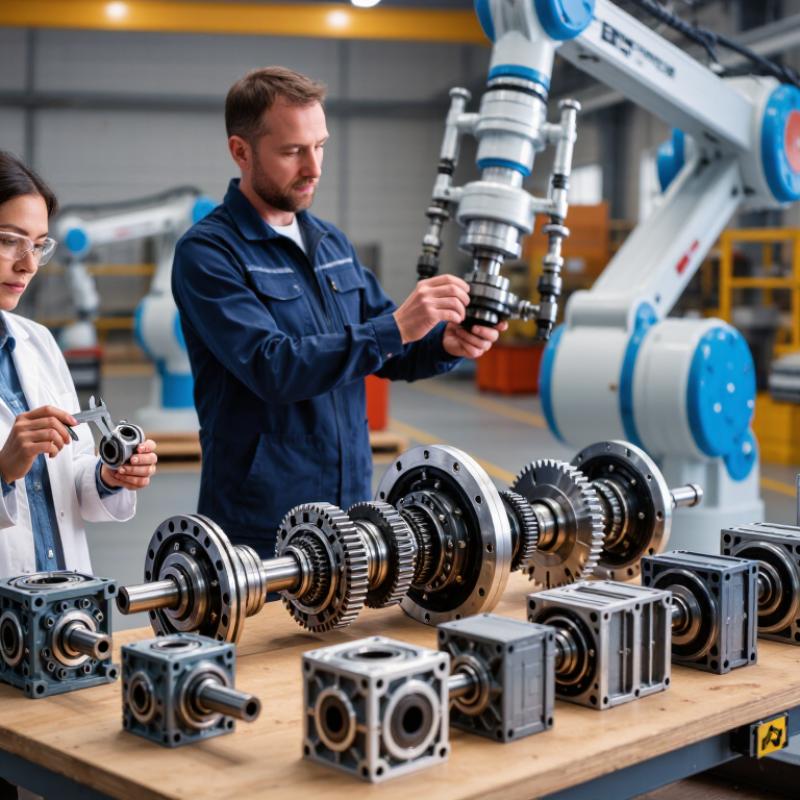
Robotic gears transfer motor power into controlled movement. They help arms lift parts, wheels climb ramps, and grippers close with measured force. In an industrial robot, a gearbox can reduce motor speed while increasing torque at a joint. Low backlash matters when a robot places a component precisely or follows a repeatable welding path. Gear teeth, bearings, and lubrication all affect noise, heat, and service life. Small details count.
The International Federation of Robotics reported 4.28 million industrial robots operating worldwide in 2023, in World Robotics 2024. That installed base makes reliable motion components a practical concern, not just a design preference. Service robots also need gears: the IFR’s World Robotics 2024 – Service Robots report recorded about 205,000 professional service robots sold in 2023.
Mobile machines may face dust, uneven floors, and frequent starts. A gear set that performs well in a clean factory may not suit those conditions. Easy to overlook. Engineers must balance torque, speed, size, noise, and maintenance access; there is rarely one perfect choice. Even careful specifications can miss real-world wear, so field testing remains essential.

When evaluating robotic gear manufacturers, start with the demands of your application. A compact joint actuator may need low backlash, while a palletizing arm may prioritize torque and service life. Ask for measured data on accuracy, noise, temperature rise, and load capacity. Request drawings and inspection records, not just catalog specifications. A polished brochure proves little.
Tips: Share your duty cycle, target speed, and operating environment. Ask whether sample gears can be tested under comparable loads. Confirm packaging, shipping timelines, and who handles technical questions after delivery.
Review how the manufacturer controls quality across production batches. Check whether inspection methods and material records are documented and traceable. For overseas orders, clarify tolerances, communication schedules, spare-part availability, and what happens when a sample fails acceptance tests. Video calls can help you inspect processes, but they cannot replace independent measurements. I have seen buyers focus heavily on unit price and overlook engineering support; that choice can become expensive when a gear needs redesign. Still, no supplier can remove every risk. Compare evidence against your own requirements, and record any unanswered questions before placing a larger order.
For global buyers, robotic gear selection starts with the joint, not the catalogue. The International Federation of Robotics reported 541,302 industrial robot installations in 2023, with 4,281,585 units operating worldwide. That scale makes repeatable torque, low backlash, and reliable heat control practical purchasing priorities. A useful ten-profile shortlist includes specialists in precision planetary, strain-wave, cycloidal, bevel, worm, spur-and-helical, hollow-shaft, low-backlash, integrated motor-reducer, and custom joint-drive systems.
Each specialty solves a different constraint. Planetary units suit compact arms needing high torque density; strain-wave designs support tight spaces and precise positioning. Cycloidal reducers tolerate shock loads, while bevel gears redirect motion through angled joints. Worm gears offer compact right-angle layouts, though efficiency and heat deserve scrutiny. Spur and helical gears serve simpler axes; hollow-shaft designs leave room for cables. Low-backlash makers target repeatability, integrated units simplify assembly, and custom-drive specialists adapt ratios to unusual payloads.
Ask suppliers for measured backlash, rated life, lubrication guidance, and thermal data under your actual duty cycle. A clean datasheet is not a field test. Fit matters. Compare the same load, speed, mounting position, and operating temperature across samples. Some specifications still omit wear behavior after long cycling; buyers should treat that gap as a real risk, not a small detail.
Robotic gear manufacturers should be compared by gear type, verified precision, production capacity, and service reach. Spur gears are compact and economical, while helical gears often run more smoothly under load. Planetary gearboxes offer high torque in a small footprint; worm gears can provide substantial reduction but may lose more energy as heat. Check backlash, runout, rated torque, and the stated test method. Precision claims mean little without measurement conditions.
Capacity matters when prototypes become recurring orders. Ask for production lead times, inspection records, material traceability, and evidence that output can scale.
The International Federation of Robotics’ World Robotics 2024 report recorded 541,302 industrial robot installations in 2023, with 4.28 million robots operating worldwide.
That installed base highlights the need for dependable replacement parts and consistent supply. Global reach also means local technical support, clear documentation, and realistic shipping estimates. A polished catalog is not proof of capability; factory audits and sample testing can expose gaps.
Tips: Match the gear to load, speed, noise, and available space. Request a sample and a dimensional inspection report. Compare quoted lead times with actual delivery history. Small differences matter.
10 Best Robotic Gear Manufacturers for Global Buyers
When comparing robotic gear manufacturers, check certifications against the exact product and facility you plan to source from. A certificate may cover a quality system, not the gear’s performance or materials. Ask for current documents, test reports, and clear traceability for critical components. Specific answers matter.
Support and delivery promises need equal scrutiny. Confirm response hours, engineering help, replacement-part availability, and the format of technical manuals. Request a written lead-time estimate for samples and production orders; these can differ sharply. Ask what happens if a gear fails inspection or a shipment slips. No checklist catches everything. Leave room for uncertainty.
Compare total cost, not just unit price. Include tooling, minimum order quantities, packaging, freight, and expected spare parts. A low quote can still be the wrong choice if service is slow or tolerances do not match your assembly. Tips: Request a sample, measure backlash and noise under realistic loads, and record acceptance criteria before placing a large order. Recheck assumptions after the first production run.
Anonymous supplier archetypes for building a shortlist—not a ranking of verified companies. Certifications, service capabilities, lead times, and costs vary by supplier, product, order size, and destination. Confirm all details directly before purchasing.
| Supplier Profile | Typical Gear Products | Certification Evidence to Check | Support to Confirm | Indicative Lead-Time Planning Range | Relative Cost | Best-Fit Sourcing Use |
|---|---|---|---|---|---|---|
| 1. Precision planetary gearbox specialist | Low-backlash planetary gearheads and servo gearboxes | Quality-management certificate such as ISO 9001; request the certificate scope and current validity | Backlash, torque, inertia, and motor-adapter selection assistance | About 4–10 weeks for standard configurations; custom designs may take longer | Medium to high | Servo axes requiring compact size, repeatability, and high torque density |
| 2. Strain-wave gear specialist | Compact, high-ratio strain-wave (harmonic-type) reducers | ISO 9001 or equivalent quality-system evidence; verify product-specific test documentation | Application support for rated torque, overloads, torsional stiffness, and life calculations | About 6–14 weeks, depending on size and configuration | High | Robot joints and positioning axes where compactness and low backlash are priorities |
| 3. Cycloidal reducer specialist | Cycloidal and pin-wheel speed reducers | Quality-system evidence; request inspection and load-test records for the ordered model | Guidance on shock loads, duty cycle, mounting, lubrication, and thermal limits | About 5–12 weeks for standard models; custom interfaces can extend delivery | Medium to high | Heavy-duty robot axes and applications with substantial impact or shock loading |
| 4. Precision planetary gearbox OEM | High-volume planetary reducers with configurable ratios and output interfaces | ISO 9001 is commonly relevant; automotive programs may require IATF 16949, where applicable | Engineering change control, production traceability, and volume-planning support | About 8–16 weeks for initial production; repeat orders may be shorter | Low to medium at volume | Repeatable designs and larger production programs with stable specifications |
| 5. Worm-gear reducer manufacturer | Worm gearboxes and right-angle speed reducers | Quality-system evidence; check applicable electrical or machinery conformity documents for the complete assembly | Advice on efficiency, heat generation, backlash, and self-locking claims | About 3–8 weeks for standard products; modified units vary | Low to medium | Cost-sensitive right-angle drives where efficiency and duty-cycle requirements are understood |
| 6. Bevel and helical gearbox supplier | Bevel, helical, and right-angle gear units | ISO 9001 or equivalent; request material, dimensional, and final-inspection records | Mounting-layout review, shaft-load checks, and lubrication recommendations | About 4–10 weeks for catalog configurations | Low to medium | Conveying, transfer, and robot peripheral axes using established gear layouts |
| 7. Custom gear and transmission house | Custom spur, helical, bevel, and multi-stage gear assemblies | Quality-system certificate and documented design, inspection, and change-control processes | Co-design, tolerance review, prototype support, and nonconformance handling | About 8–20 weeks for first articles; timing depends heavily on tooling and validation | High for prototypes; project-dependent at volume | Nonstandard geometry, special materials, or integrated transmission assemblies |
| 8. Miniature gearbox manufacturer | Small planetary and spur gearboxes for compact robotic devices | ISO 9001 or equivalent; verify miniature-unit test methods and product traceability | Support for low-load testing, noise, efficiency, and motor matching | About 4–12 weeks, depending on customization and order quantity | Medium | Compact manipulators, grippers, inspection devices, and mobile robots |
| 9. Integrated actuator and gearbox supplier | Gearbox assemblies combined with motors, encoders, or brakes | Check quality-system evidence and applicable conformity documentation for the supplied assembly; component certificates alone may not cover the system | System-level sizing, wiring documentation, integration guidance, and warranty process | About 6–14 weeks for standard assemblies; configured systems may take longer | Medium to high | Projects seeking fewer interfaces and a single source for drivetrain components |
| 10. Regional stocking distributor with engineering support | Catalog gearboxes and replacement units from multiple manufacturers | Verify authorized sourcing, product traceability, and the original manufacturer’s documentation | Local-language assistance, stock checks, returns handling, and regional technical support | In-stock items may ship within days; replenishment can take several weeks | Medium; may include a distribution premium | Urgent replacements, smaller orders, and buyers prioritizing local service |
Buyer checks: Treat lead-time ranges as planning estimates, not supplier commitments. Request a dated quotation, Incoterm, delivery schedule, warranty terms, spare-parts policy, and country-of-origin details. Validate certificates with the issuing body where practical. ISO 9001 is a quality-management system standard; it does not by itself certify a gearbox’s performance or safety. Product conformity requirements depend on the product, its intended use, and the destination market.