Choosing a Solid State Diode Laser manufacturer takes more than comparing headline power or price. Buyers need to match wavelength, output stability, beam quality, cooling method, and service support to the actual application. A compact blue module on a laboratory bench has different requirements from a high-duty industrial source. Small details matter.
Grand View Research’s Laser Technology Market report estimated the global laser market at USD 20.21 billion in 2023 and projected a 10.1% compound annual growth rate from 2024 to 2030. This broad market estimate provides useful context, but it does not isolate solid-state diode laser systems. That distinction matters. Market size alone cannot confirm a supplier’s technical fit or delivery reliability.
This guide examines manufacturers through practical buyer criteria: published specifications, product range, customization options, quality documentation, and application support. Look for clear test conditions behind stated power and lifetime figures. Ask how performance changes with temperature, duty cycle, and operating hours. A datasheet can look convincing. Real deployment may be less tidy. Manufacturer claims should be checked against test reports, warranty terms, and relevant customer experience. The following shortlist is a starting point, not a substitute for qualification testing.
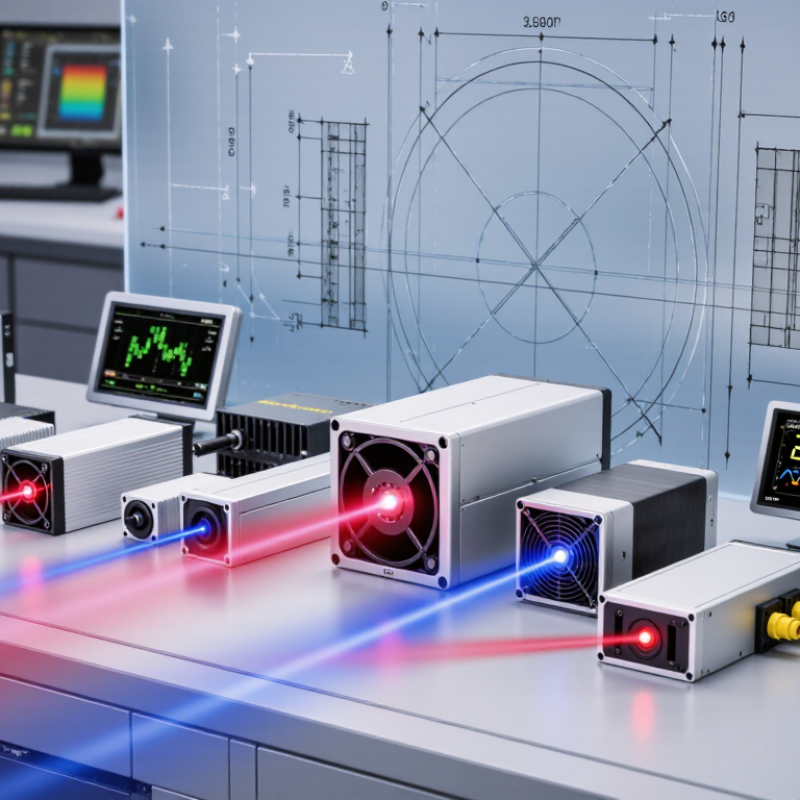
A solid-state diode laser produces light within a semiconductor junction. When electric current passes through it, electrons and holes recombine and release photons. The junction and its optical cavity help create a focused, coherent beam. Compact and efficient, these lasers can fit into handheld instruments or tightly packed systems. They still need careful heat management.
Common forms include edge-emitting diodes, which send light from the chip’s side, and VCSELs, which emit perpendicular to its surface. High-power diode bars combine many emitters for greater output. One distinction matters: a direct diode laser uses semiconductor light as its output, while a diode-pumped solid-state laser uses that light to energize a separate crystal. The names sound similar, but the beam paths differ.
Applications include material processing, medical equipment, sensing, communications, and research. In a workshop, a diode system may cut or mark material; in a laboratory, a lower-power unit may measure distance or illuminate a sample. Wavelength, beam quality, output power, and cooling needs all affect suitability. Specifications alone can be misleading. Real performance also depends on alignment, duty cycle, and the surrounding optics, so buyers should compare systems under realistic operating conditions.
Buyer-oriented technology comparison. “Solid-state diode laser” commonly refers to a semiconductor laser diode; a diode-pumped solid-state (DPSS) laser is a distinct laser in which a diode pumps a solid gain medium. Values below are representative examples, not guaranteed specifications or a supplier ranking.
| Technology or supplier offering | Definition and operating principle | Common wavelength examples | Typical output format | Core applications | Buyer checks |
|---|---|---|---|---|---|
| Visible semiconductor diode lasers | A forward-biased semiconductor junction generates laser light directly. Visible wavelengths are commonly produced by semiconductor materials such as GaN-based and AlGaInP-based devices. | Approximately 405 nm, 445–455 nm, 520 nm, and 635–690 nm, depending on device material and design. | Packaged single emitters range from milliwatt-class to multiwatt-class products; higher outputs may use multiple emitters or arrays. | Display and projection systems, fluorescence excitation, machine vision, alignment, optical storage, and selected medical or laboratory instruments. | Check wavelength tolerance, spectral width, beam divergence, operating current, thermal limits, optical feedback sensitivity, and required eye-safety controls. |
| Near-infrared diode lasers | Direct-emitting semiconductor lasers designed for near-infrared output. Common diode families include GaAs-based devices. | Common examples include 808 nm, 915 nm, 940 nm, and 976–980 nm. | Available as single emitters, bars, stacks, and fiber-coupled modules; power varies widely by package and cooling method. | Pumping solid-state and fiber lasers, illumination, sensing, spectroscopy, and materials processing. | Confirm wavelength at the intended current and temperature, coupling efficiency, fiber-core and numerical-aperture requirements, cooling needs, and rated lifetime conditions. |
| Telecom-band semiconductor diode lasers | Semiconductor sources engineered for fiber-optic communication and related photonic systems, often using InGaAsP-based structures. | Around 1310 nm and 1550 nm. | Commonly supplied in fiber-coupled or hermetically packaged formats, with output and modulation options determined by the device class. | Fiber-optic communications, optical sensing, ranging, and instrumentation. | Check modulation bandwidth, linewidth, side-mode suppression, fiber connector, polarization, temperature stabilization, and applicable telecom standards. |
| High-power direct-diode modules | One or more semiconductor emitters deliver process light directly, without converting it through a separate solid-state gain crystal. | Often uses near-infrared bands such as approximately 808–980 nm; some systems combine or select other wavelengths for a process. | Bar, stack, free-space, or fiber-coupled modules; multi-emitter products can reach high optical power, subject to design and cooling. | Metal and polymer processing, heat treatment, brazing, cladding, pumping, and industrial illumination. | Compare output power at the workpiece, beam profile, spot size, power stability, cooling interface, electrical efficiency, serviceability, and integration requirements. |
| Diode-pumped solid-state (DPSS) lasers | A semiconductor diode pumps a solid gain medium, such as a crystal. The output wavelength is produced by the gain medium and may be changed by frequency conversion. | Common examples include 1064 nm from Nd:YAG or Nd:YVO4, 532 nm after frequency doubling, and 355 nm after further harmonic conversion. | Often supplied as a complete laser head or system; available in continuous-wave and pulsed configurations, depending on design. | Precision marking, micromachining, spectroscopy, scientific research, and medical or industrial systems. | Specify output wavelength, pulse duration and repetition rate or CW power, beam quality, stability, cooling, and conversion-stage maintenance. |
| Common sourcing formats | Suppliers may focus on semiconductor chips, packaged laser diodes, optical modules, or integrated laser systems. These are product and integration categories, not a ranking of manufacturers. | Selected according to the target wavelength and application; verify that the supplier specifies the wavelength under stated operating conditions. | Bare die; packaged component; collimated or fiber-coupled module; complete laser source or processing system. | Component development, OEM integration, laboratory use, and turnkey industrial deployment. | Assess test reports, traceability, sample availability, customization capability, warranty, technical support, compliance documents, and continuity of supply. |
Selection note: Output power, wavelength, beam quality, lifetime, and efficiency depend on the specific device, drive conditions, temperature, and package. Compare specifications measured under equivalent conditions, and include thermal management and laser-safety requirements in the system design.